

The Transparent Alternative: Flat Baselines, Regressive Unit Economics, and 90-Day Buyout Models
ProfilePilot Team | Apr 22, 2026 | 8 min read
A transparent pricing architecture helps agencies protect margin, stabilize EBITDA, and scale without software overhead penalties.
What Transparent Agency Pricing Looks Like
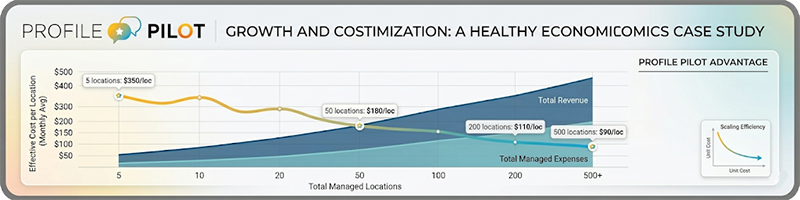
What Transparent Agency Pricing Actually Looks Like
A sustainable, margin-protective pricing model operates in direct opposition to the legacy structures utilized by the industry's oldest providers. When evaluating your next technology partner, a truly transparent architecture must include the following four pillars:
1. Predictable (or Non-Existent) Baseline Platform Access
Legacy platforms disguise their high costs through a "Dashboard Tax"—charging $275 to $499 monthly just for the privilege of logging in. A transparent alternative completely flattens this baseline. You should not pay a premium simply to access the administrative shell of the software. Capital should only be exchanged for actual, tangible value, which in this ecosystem translates directly to the number of active client locations you are managing.
2. Regressive Unit Economics as Location Volume Grows
Many platforms charge a flat retail multiplier (e.g., a rigid $50 per location), or they force you into rigid tier buckets where adding a single new client triggers a massive software upgrade fee. Transparent platforms utilize regressive unit economics. This means that as your location volume grows, your wholesale cost per location mathematically decreases. It creates a sliding scale that actively rewards your agency for scaling, rather than penalizing your expansion.
3. No Hidden Dashboard Taxes
True transparency means zero post-signature surprises. This requires the complete elimination of arbitrary seat floors (e.g., being forced to pay for 10 users when you only need three). Furthermore, it mandates the removal of the "White-Label Tax." Establishing a custom CNAME domain and provisioning an SSL certificate is a basic, automated server function; vendors that charge a $400+ annual premium for this are simply price-gouging.
4. Fair Migration Pathways (The 90-Day Buyout Model)
The biggest hurdle to adopting a transparent tech stack is the rigid 12-month contract enforced by legacy providers. Agencies often find themselves mathematically trapped, unable to migrate because they cannot afford to double-pay software fees during the transition. A transparent partner solves this through aggressive migration pathways, such as a 90-Day Buyout Model. Under this structure, the new software provider absorbs or credits the remainder of your legacy contract (up to 90 days), completely removing the financial friction and lock-in penalties of migrating your client base.
If you are new to this economic series and want to understand the exact mechanics of how vendors trap agencies, begin with our foundational research: The Hidden Dashboard Tax.
Why This Fundamentally Changes Agency Outcomes
Shifting from a punitive pricing model to a transparent one is not merely an administrative software swap; it is a macro-level financial strategy that dictates how your agency operates and grows.
Capital Allocation with Confidence When your Cost of Goods Sold (COGS) is perfectly predictable and heavily tied to regressive unit economics, your gross profit margins expand. This allows agency operators to allocate capital with absolute confidence. Instead of hoarding cash to pay for unexpected software overages or tier upgrades, you can confidently deploy capital toward hiring new account managers, funding outbound acquisition campaigns, and investing in client retention systems.
For agency founders eyeing a future exit, merger, or acquisition, financial predictability is everything. EBITDA (Earnings Before Interest, Taxes, Depreciation, and Amortization) is the core metric used to calculate an agency's valuation multiplier. When a legacy software vendor captures your margin through hidden fees, your EBITDA is artificially suppressed. By migrating to a transparent platform with predictable unit math, you immediately stabilize and increase your EBITDA, which materially improves your agency's valuation in any acquisition scenario.
Apply the Framework to Your Tech Stack
Do not allow your technology vendors to extract the profit margins you worked so hard to build. Run a three-scenario financial model (conservative, target, aggressive) against your current reputation management toolset and compare the TCO against transparent alternatives.
Your Procurement Checklist:
-
Understand the technical requirements of the platform by reading What True White-Label Actually Requires .
-
Master the unit math of wholesale billing in The Per-Location Illusion.
-
Estimate Your Growth: Use the live, interactive pricing calculator on ProfilePilot Partners to instantly estimate your monthly and annual margin uplift when you switch to a truly transparent pricing curve.
Keep learning
See the latest guides, experiments, and rollouts.